





Shadows in Sync: A Deep Technical Analysis of Cooperative Horror in Little Nightmares III
The evolution of the Little Nightmares franchise has always been a journey through the grotesque and the miniature. However, Little Nightmares III introduces a fundamental shift in the series' DNA: the transition from solitary confinement to the dual-protagonist synergy of Low and Alone. This shift isn't merely a narrative choice; it is a profound mechanical overhaul that redefines how players interact with environmental hazards, AI-driven entities, and spatial puzzles. To master the Spiral, one must look beyond the haunting aesthetic and deconstruct the game’s physics-based cooperation, the asymmetrical utility of the protagonists’ tools, and the predictive AI patterns of the terrifying residents inhabiting the Nowhere. This guide explores the technical depths of these systems, offering a manifesto on how to survive the most ambitious entry in the series to date.
1. The Architecture of Co-op: Physics-Based Synergy
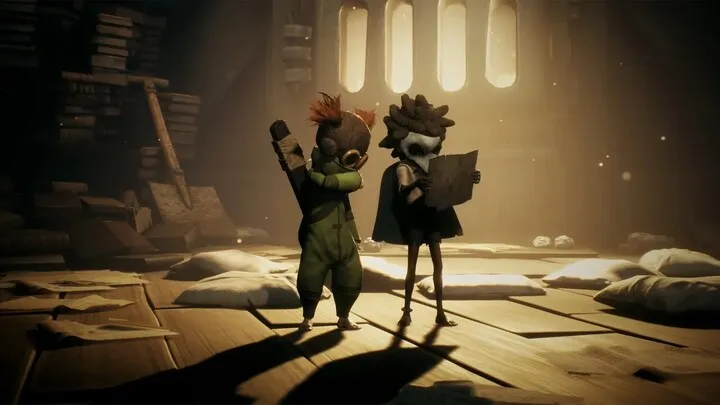
At its core, Little Nightmares III is built upon a proprietary engine designed to handle real-time physics interactions between two distinct entities. Unlike previous entries where NPCs were largely passive or followed strict scripted paths, the relationship between Low and Alone is dynamic. Every puzzle in the "Spiral" requires a "Force-Vector" analysis. For instance, when pushing heavy objects or operating complex machinery, the game calculates the combined input of both players. This means that timing is no longer just a suggestion; it is a mechanical requirement.
The technical brilliance lies in the "Weight-Shift" mechanic. Certain platforms and environmental traps respond to the specific distribution of mass. If Low and Alone stand too close together on a fragile ledge, the structural integrity of that asset will deplete twice as fast. Mastering the game involves understanding how to "De-sync" your movements to manage environmental stressors. This asymmetrical approach to platforming ensures that players are constantly communicating, not just about where to go, but about the specific physical pressure they are exerting on the world.
2. Low’s Bow: Precision Projectiles and Long-Range Manipulation
Low is the designated "Long-Range Specialist" of the duo, and his bow is far more than a simple weapon. In the technical landscape of Little Nightmares III, the bow acts as a remote trigger for environmental physics. The arrow’s trajectory is governed by a gravitational arc that requires the player to account for "Drop-Off" over long distances. This introduces a skill ceiling for puzzle-solving that didn't exist in previous games.
Advanced Bow Applications
- Trigger Weighting: Some buttons are "Pressure-Sensitive." Shooting them doesn't just toggle them; the impact of the arrow provides a momentary "Hit-Stun" that can delay a trap’s activation.
- Elastic Interaction: Arrows can be used to sever ropes or trigger pulleys. The "Line-of-Sight" physics in the game are extremely precise; if even a pixel of a hitbox is obscured, the shot will fail, demanding high-level accuracy during intense chase sequences.
- Distraction Vectors: The sound of an arrow hitting a metal surface generates a "Sound Bubble" that AI enemies will investigate. Technical players use this to manipulate enemy pathing, creating windows for Alone to move through high-risk zones.
3. Alone’s Wrench: Structural Destruction and Mechanical Overrides
In contrast to Low’s finesse, Alone represents "Destructive Utility." Her wrench is a heavy-duty tool used for dismantling the environment and overriding rusted machinery. Mechanically, the wrench operates on a "Torque System." When turning cranks or loosening bolts, the player must manage a stamina-like meter that simulates physical resistance. If you attempt to override a machine too quickly, Alone will suffer an "Action-Stun," leaving her vulnerable to nearby threats.
The wrench also serves as the primary tool for "Structural Bypassing." Throughout the Spiral, there are "Weak-Point Geometry" assets—walls or floors that can be demolished. Unlike the bow, which interacts with the world via projectiles, the wrench requires "Contact Physics." This forces Alone to occupy the most dangerous spaces in a room. To master Alone, a player must learn the "Strike-Recovery" timing, ensuring that they can swing, destroy an obstacle, and recover into a sprint before a Resident can close the gap.
4. The Anatomy of Stealth: Sound Spheres and Visual Cones
Stealth in Little Nightmares III has been refined into a highly legible but unforgiving system of "Detection Bubbles." Every Resident in the game possesses a unique AI profile that dictates their sensory range. Some enemies are "Light-Sensitive," reacting only to the glow of your flashlight, while others are "Vibration-Focused," detecting the ripples in the sand of the Necropolis.
Stealth Priority Checklist
- Surface Dampening: Moving on carpet versus moving on metal grating affects the radius of your "Sound Sphere."
- Synchronized Crouching: When both players move in sync, the game’s audio engine overlaps the footsteps, slightly reducing the combined detection radius compared to two players moving independently.
- Environmental Occlusion: Hiding behind an object doesn't just break the line of sight; it acts as an "Audio Muffler." If a Resident is on the other side of a thick wooden door, Alone can use her wrench with significantly less risk of detection.
5. Navigating the Necropolis: Wind Resistance and Sand Physics
The Necropolis serves as the game’s first major technical hurdle, introducing "Atmospheric Physics." The wind in this region isn't just an aesthetic effect; it applies a constant force vector to the characters. When leaping between high-altitude ruins, players must account for "Wind Push." Jumping against the wind results in a shorter jump arc, while jumping with the wind can propel Low and Alone across gaps that seem impossible.
Sand physics further complicate the movement engine. Walking through deep sand introduces "Drag," slowing your base movement speed by approximately 30%. However, the sand can also be used as a "Fall Damper." Falling from a height that would normally be fatal (resulting in a "Bone-Snap" animation) is survivable if you land in a deep sand dune. Technical navigation in the Necropolis requires constant assessment of the ground texture and the current wind direction to maintain optimal velocity.
6. Resident AI Patterns: Predictive Loop Analysis
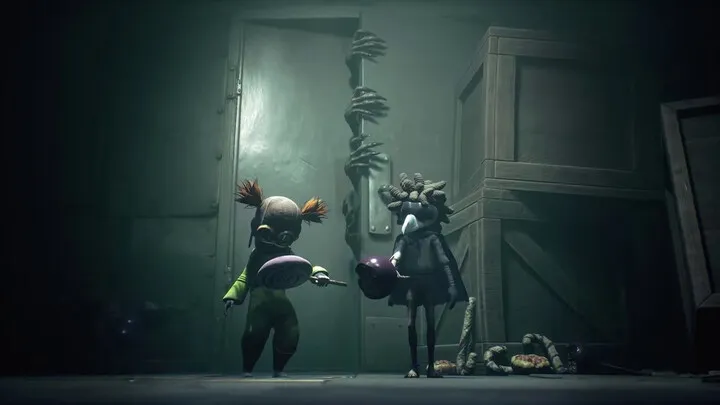
The "Residents" (the antagonists) of Little Nightmares III operate on a "State-Machine" logic. They transition between Patrol, Suspicion, and Aggression. Unlike earlier games, the AI in this entry is "Collaborative-Aware." If a Resident spots Low, it will not only chase him but will occasionally look for his partner, Alone. This "Searching Logic" forces players to stay separated or find clever ways to cross-cover each other.
Analyzing the "Monster Baby" Cycle
The Monster Baby in the Necropolis is a titan-scale threat with a massive "Vision Cone." To survive its sequences, you must understand its "Blink Cycle." Every few seconds, the Baby’s focus shifts, and its hand-swipes follow a predictable "Arc-Pattern." By timing your sprints to coincide with the "Cool-Down" of its search animation, you can move through the open desert safely. This is where the bow becomes vital—Low can shoot objects in the distance to draw the Baby’s gaze, allowing Alone to move through the Baby’s "Blind Spot."
7. The Umbrella and the Abyss: Aerial Synergy
One of the most innovative mechanical additions is the "Umbrella" (or paragliding tool) used in certain vertical segments. This introduces a "Flight Model" to the Little Nightmares engine. While gliding, the protagonists are subject to "Thermal Updrafts." Managing your altitude requires "Angle-of-Attack" adjustments—pitching the umbrella up to gain height (at the cost of speed) or pitching down to gain momentum.
This mechanic often requires Low to provide "Cover Fire" while gliding. In some sequences, Alone must steer the duo while Low shoots at airborne threats or triggers floating targets. The technical difficulty here lies in the "Shared Momentum." Because they are holding onto the same tool, their inputs are additive. If one player steers left and the other right, the umbrella stalls. Mastering the "Aerial Glide" is the ultimate test of cooperative synchronization in the game.
8. Managing the "Spiral" Currency: Collectibles and Lore
While Little Nightmares III is primarily an action-adventure game, it features a "Knowledge Economy" through its collectibles. Finding "Memorabilia" isn't just for completionists; it often reveals clues about the specific weaknesses of the Residents. For example, finding a specific collectible in the Necropolis might hint at a Resident’s aversion to a certain sound or light frequency.
Collectible Hierarchies
- Spirits: Hidden entities that, when interacted with, trigger "Echo-Vision," revealing the path a Resident took previously.
- Memorabilia: Physical items that provide context to the Nowhere’s history.
- Secrets: These are often hidden behind "Dual-Action Walls"—obstacles that require Alone to break the surface and Low to shoot a trigger inside the hole.
9. AI Partner Management: Commands and Coordination
For those playing in single-player mode, Little Nightmares III utilizes a robust "Friendship AI" to control the second protagonist. The AI is designed to be "Proactive" rather than "Reactive." If you are Alone, the AI-controlled Low will automatically scan the environment for projectile targets. However, the player can issue "Focus Commands" to direct the AI’s attention.
The technical secret to single-player success is "Pre-Loading Actions." You can command your partner to hold a lever while you move to a gate. The AI will hold that position until you clear the threshold or until it detects imminent danger. Understanding the AI’s "Threat-Assessment Threshold" is key; the AI will prioritize survival over your command if an enemy gets too close, so you must ensure the area is safe before initiating complex dual-tasks.
10. The Climax of Cooperation: Endgame Boss Mechanics
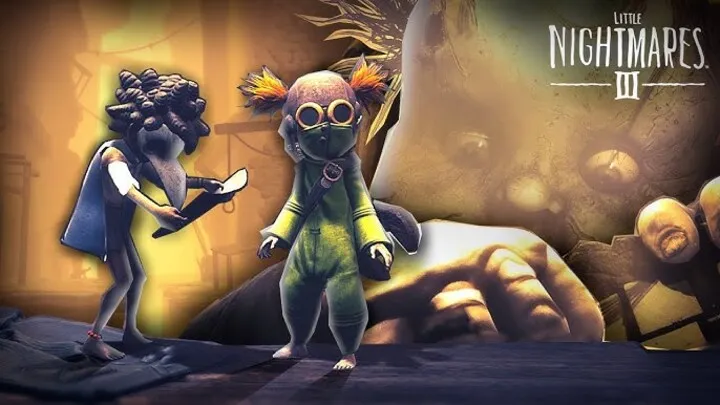
The final stages of Little Nightmares III abandon the "Hide-and-Seek" stealth and move into "Combat-Puzzle" territory. These encounters are a stress test of every mechanic mentioned above. You will be required to manage "Simultaneous Triggers" where Low must hit a sequence of targets in mid-air while Alone dismantles the boss’s armor on the ground.
These endgame bosses utilize "Dynamic Arena Destruction." As the fight progresses, parts of the floor will fall away, and the wind will intensify. This requires "Spatial Budgeting"—knowing exactly which platforms are safe to stand on and for how long. The bosses also introduce "Status Effects" like "Gloom-Blindness," where one player’s screen goes dark, forcing the other player to "Call-Out" directions and hazards. This is the ultimate narrative and technical expression of the game’s core theme: that no one survives the Nowhere alone.
Conclusion
Little Nightmares III is a testament to the power of cooperative game design within the horror genre. By grounding its terrors in the tangible laws of physics and the intricate synergy of its two protagonists, Supermassive Games has created an experience that is as technically demanding as it is atmospheric. Mastering the game is an exercise in empathy and precision—understanding the weight of your partner, the arc of an arrow, and the torque of a wrench. As Low and Alone navigate the haunting beauty of the Spiral, players are reminded that while the shadows are vast and the Residents are many, the bond between two tiny souls is the most powerful tool of all. Survival in the Nowhere isn't just about outrunning your nightmares; it's about learning to move in sync with them.